
Sheboygan Previous Resident Sources
A backward address trail changes with the era. Modern parcels and permits supply a firm starting point, deeds follow title, and older directories or census schedules test whether an owner or another household actually occupied the site. Sheboygan has useful nineteenth-century directory and map holdings, but no single online index spans the whole period. Treat each row as one layer of evidence.
| Source | Years It Covers | Where Held | What It Shows |
|---|---|---|---|
| Deed index and instruments | Index reported back to 1938; older books require confirmation | Sheboygan County Register of Deeds | Grantor, grantee, dates, and legal description |
| City and county directories | Verified items 1875–1920; later holdings vary | UW Digital Collections, Mead, SCHRC | Name, address, occupation, and household clues |
| Federal census | Mead microfilm 1820–1920 except destroyed 1890 | Mead and federal genealogy sources | Household members and enumeration context |
| Building permits | Online October 2015–current; older records at office | City Building Inspection | Project, permit type, dates, and applicant clues |
| Maps, news, and local files | 1884 map plus varied newspaper/archive runs | LOC, Mead, SCHRC, WHS | Building form, events, and address changes |
Start with the county tax portal for a present parcel, but do not call its owner field a list of present residents. For a recent building change, use the permit trail. For the late nineteenth or early twentieth century, pair a dated directory with a period map and census year. The 1890 federal census is unavailable because it was destroyed by fire, so directories and newspapers have greater value for that gap.
Sheboygan Deeds Backward
The county property portal provides the current parcel, tax owner, and abbreviated legal description. Use that only as the starting reference. The Register of Deeds real-estate route holds deeds, mortgages, releases, easements, and plats. The recorded deed, not the tax summary, supplies the full legal description and transfer parties.
- Record the current parcel ID, site address, tax owner, and legal description.
- Locate the current purchase deed and read the actual image or obtain a copy.
- Note its grantor, then search that seller as a grantee to find the seller's earlier purchase.
- Repeat the link, logging document number, volume/page, execution date, recording date, and description.
- Ask the office about deed books or repository access when the public index ends.
- Grantor and grantee
- The grantor transfers an interest; the grantee receives it.
- Chain of title
- The linked sequence of recorded transfers for one property.
- Legal description
- The land description in the instrument. It survives many street-number changes better than a mailing address.
- Situs address
- The mapped property location, which can differ from the owner's mailing address.
County reporting says back-indexing closed a 1932–38 gap and reached 1938. E-recording began in 2008, while the first e-recorded deed arrived in 2010. Those dates describe indexing and submission, not guaranteed free images for every instrument. Call 920-459-3023 with a document number or volume and page when the portal does not expose what is needed.
Sheboygan House History Service
The Sheboygan County Historical Research Center offers a paid historic-house study for $200 per property. Its report may include an approximate construction date, first owner and occupation, original use, major changes, a chronology of owners and occupants, architect or contractor, notable events, neighborhood ties, photographs, and a source list. That scope is broader than a title search because it can combine deeds with directories, maps, news, and local files.
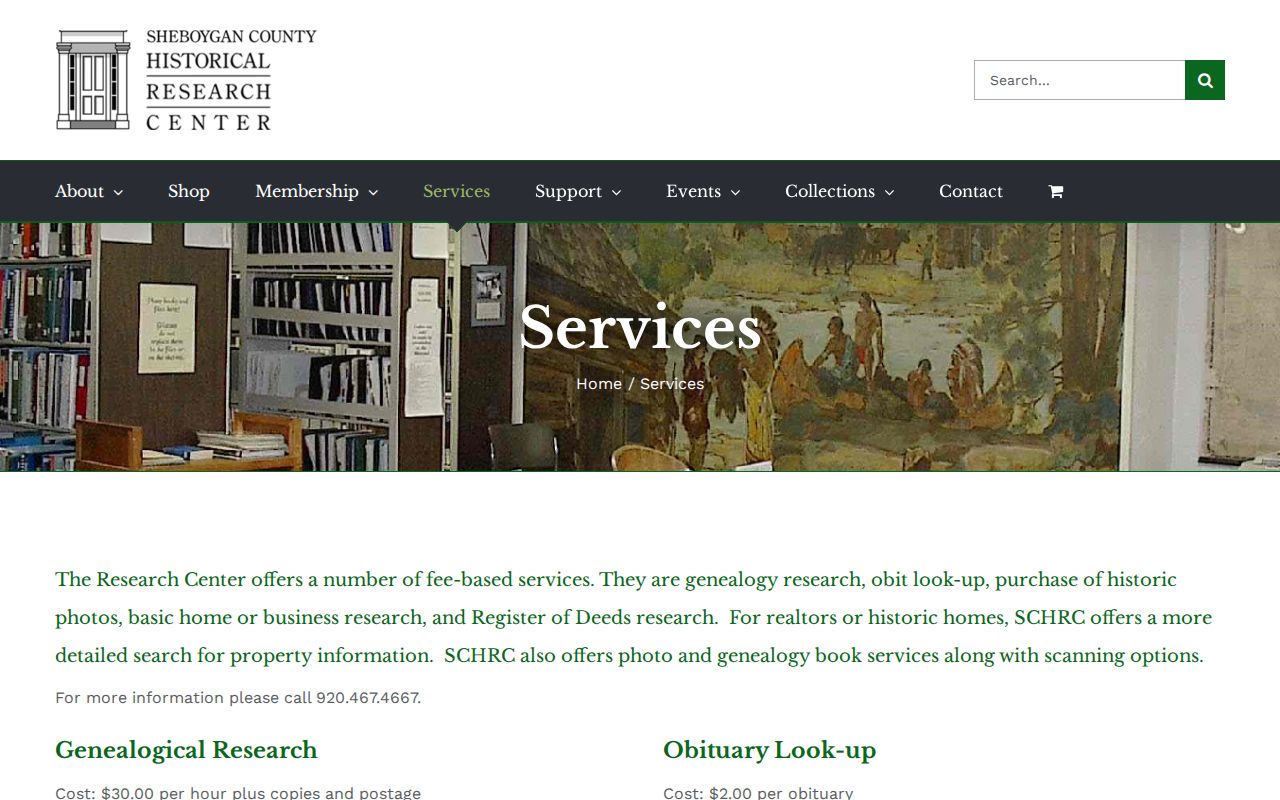
The image below is linked to the SCHRC services description.
Requests go to research@schrc.org or 920-467-4667. The center is at 518 Water Street in Sheboygan Falls and lists Tuesday through Friday hours, with Saturday by appointment. Provide one address, known former numbers, parcel or legal description, and a date range. A narrow request lets staff distinguish a resident from a similarly named person.
Map Past Sheboygan Residents
Address numbers and parcel shapes can change. The current county parcel layer reflects splits and mergers, while the tax-year layer is a January 1 representation and does not. For an unaddressed or altered parcel, search by parcel ID or zoom manually. Next compare the legal description with a platbook or the 1884 Sheboygan Sanborn map. Sanborn maps show building footprints and uses, not a complete list of occupants.
The City Building Inspection search accepts house NUMBER and STREET for permits and inspections from October 2015 forward. Older permits are held at the office. Building, electrical, HVAC, and plumbing records are separate. A permit can date an addition or identify an applicant, but it does not prove that applicant lived there. Call 920-459-3477 about a specific property and period.
When an old number fails, search the exact spelling in directories and newspapers, then bridge to block, lot, plat, or legal description. No definitive online Sheboygan renumbering crosswalk was located. Preserve both old and current forms in the research log.
Sheboygan Past Households
Owners are only half of an address story. The Sheboygan city directory collections can place a name at a house in one publication year, often with an occupation or organization. UW has 25 digitized volumes or items, with verified title points from 1875–76 through 1920. Mead confirms 1875–98 directories plus later telephone and reference holdings. Do not assume each year exists or that every volume has a reverse, street-first section.
- Find the surname in one directory and record title, year, page, spelling, occupation, and full address.
- Check the street or criss-cross section if that volume includes one.
- Compare at least two directory years to bracket a move.
- Pair the address with a federal or Wisconsin census schedule near that period.
- Use newspapers, obituaries, and probate only to test the link, not to fill gaps by guesswork.
Mead’s newspaper holdings include the Sheboygan Press from December 1907 forward, older English and German titles, and indexed local material. Its obituary index covers 1968–95, while SCHRC now maintains the obituary index. A death notice may name relatives, an address, church, or former home, but the publication date and exact wording must be retained.
Lawful use. Research previous residents for house history, family history, heirs, or personal curiosity. Never use an address trail to track, harass, or harm a living person.
Label every finding by evidence type: deed owner, tax owner, directory listing, census household member, newspaper mention, permit applicant, mailing recipient, or unknown. The label prevents a transfer record from becoming an unsupported occupancy claim. It also makes contradictions easier to resolve when two people share a name or the property changed boundaries.
Sheboygan Record Era Changes
Access varies sharply by date. Sheboygan County reports that deed back-indexing reached 1938 after closing a 1932–38 gap. E-recording began in August 2008, and the first deed submitted that way arrived in January 2010. Those milestones do not make older books incomplete or newer images universally free. They tell a researcher when an office call may be more productive than another web search.
County scanning and land-record modernization continued through 2025 and 2026. A saved portal link may move, and an index may deepen after a project finishes. Keep the date accessed, ask whether indexing and imaging are both complete, and request a certified copy only when an official copy is needed.
Sheboygan Resident News Clues
Mead’s local newspapers can explain an address change between directory years. The Sheboygan Press run begins in December 1907, while earlier titles include the Sheboygan Telegram, Daily Press, Evening Press, and Mercury. Search the exact street form, then try the surname with a workplace, church, or relative. A news mention can support association with a place, but it is not equal to a deed or census household entry.
The library’s manual Press index covers local features through 2008, and its obituary index spans 1968–95; SCHRC now maintains the obituary index. Record the title, issue date, page, and wording. An obituary that says “formerly of” marks a prior link and should not be treated as the person’s address on the publication date.
Log Sheboygan Previous Residents
Build a dated evidence log rather than one undifferentiated list. For each name, record the source, year, exact address, page or document number, and evidence label. Note whether the source shows a deed owner, tax owner, directory listing, census household member, permit applicant, mailing recipient, or newspaper mention. Conflicts often become clear once those roles are separated.
Compare at least two directory years before describing a continuous stay. Mark parcel splits, mergers, street renumbering, and spelling changes. If only a tax mailing address links a person to the parcel, say so. Leaving an interval unknown is more accurate than turning an owner or applicant into an unsupported previous resident.